
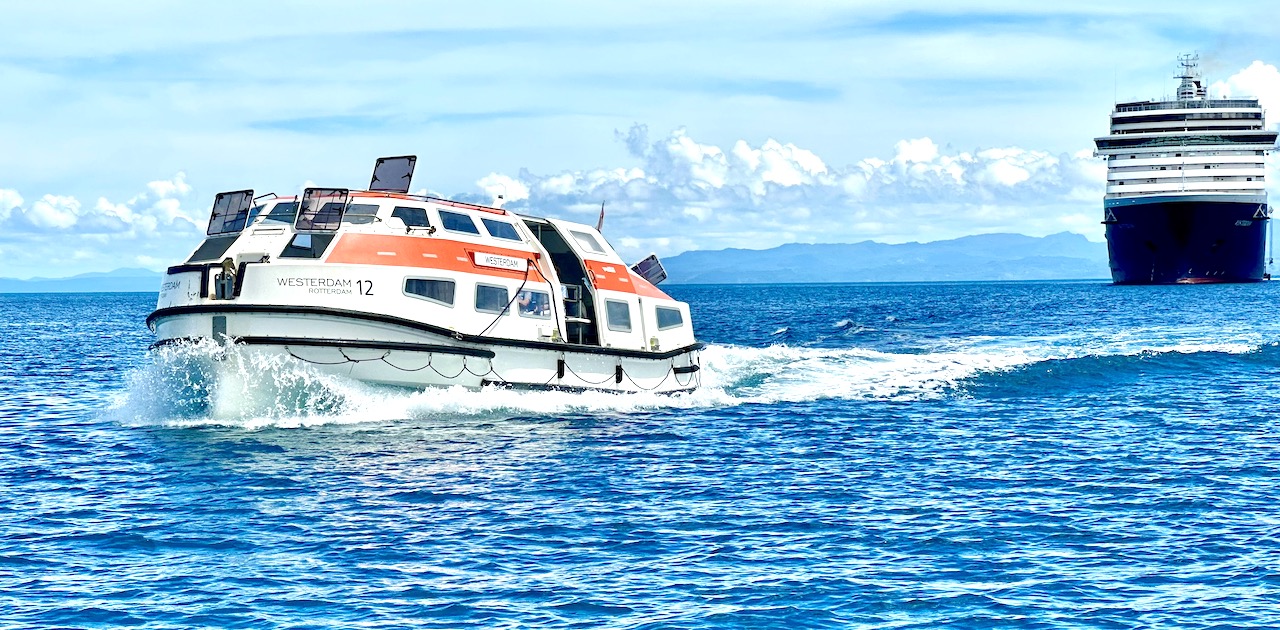
More South Pacific island destinations on HAL Westerdam; Suva, Fiji, the New York of the South Pacific; quick geography lesson; to buy suva-nirs, or not; dire deviation warning; museum curiosities: curiouser and curiouser; mindless beach day on Fiji’s Dravuni Island; Savusavu Fiji’s land rights and Roy’s pearl of wisdom; quasi-Christian coffee with a side of slavery; hot springs and directional inexactitude; Savusavu scenes; oops, and American Samoa!; octogenerian bladders and missionary zeal on a tedious tour
South Pacific Island Destinations:
Suva City, Viti Levu

According to the port talk, Suva is grandiosely known as “the New York of the South Pacific”… and yes, it feels like a capital city, with its broad streets and solid, sometimes fancy colonial-style buildings.
We’ve cruised overnight on the Westerdam from the port of Lautoka on the northwestern side of Viti Levu, the bigger of Fiji’s two main islands, to Suva on the south-eastern side of Viti Levu. Here’s a handy map, shamelessly filched from the internet. (From Suva, we’ll be cruising to Dravuni Island – too small to locate here – and from there to Savusavu on Vanua Levu, the smaller of Fiji’s two main islands. And now, as geography has never been my strongest subject, let’s move on.)

Most of what you might wish to see is within walking distance, at least for the able-bodied. Not only is tendering unnecessary, neither are shuttle buses to get from port to city. And the ship is moored almost startlingly close to the downtown area.

That includes Suva Municipal Market and the nearby handicrafts market. The former is great, and worth a wander; but the handicrafts market is a bit oppressive, unless you actually want to be lured into one of the cubicles and be sold souvenirs destined to gather dust in a box until your children are forced to throw them out one day.
From there, you turn right on to Victoria Parade and keep on going, all the way.

A canal in downtown Suva: that red wall is the back bit of the building in the previous photo, and there’s the ship in the left-side background again.


Warning!
This is what happens when you deviate from the planned route along Victoria Parade, and insist on taking a right to check out the stretch of waterfront where there is no shade. Not only will you get very hot and even more irritable, but you might also get a bad photo of a terrible boat like the one below. (So sorry, Roy.)

Back on course

Next up are the Parliamentary buildings (below). They house the offices of the Prime Minister, the High Court and several government ministries.

Something about the place, probably the enormous and meticulously manicured lawns and the sweaty humidity, reminds us of the iconic Padang in Singapore. Directly opposite this ginormous field is the entrance to Thurston Gardens, which house the excellent Fiji Museum (entry $20 Fijian per person, roughly US$10) and form part of the Botanical Gardens.

Curiosities curiouser and curiouser
After enjoying a couple of hours wandering around the Fiji Museum, (a) admiring artefacts dating back nearly four millennia, (b) learning a lot about the contribution of indentured Indian immigrants and a bit about Chinese immigration to Fiji, what most struck me as strange was the almost complete absence of reference to British rule. (Apart from a couple of pieces from the HMS Bounty, which are more of a curiosity than anything else.)
In fact, Britain established the Crown Colony of Fiji in 1874 and ruled until its Independence in 1970. After a relatively stable 17 years, ethnic tensions between Fijians and Indo-Fijians, today more than 38% of the total population, led to political instability marked by several coups.
Hmm… whose fault was that? It was the first British Governor, Sir Arthur Gordon, who allowed the Fijian chiefs to govern as before and protected the Fijian culture and way of life by ruling that native Fijian lands could not be sold, only leased. That was what our taxi-driver from Lautoka to Ba (previous post, click here) was talking about. As one of the Indo-Fijians deprived of land ownership, he was understandably not a fan.
That may be why a fairly specific chunk of history appears to be missing from the museum. Can you blame them?
Grand Pacific Hotel, Suva

Every previous colonial city has to have its grand old hotel. Singapore has the Raffles; Hanoi has the Sofitel Legend Metropole; Penang has the charming E&O. (We lucky fish have stayed at all three of those.) And Suva has its Grand Pacific Hotel.
______________________________________________
South Pacific Island Destinations:
Dravuni Island
After such a chunk of Fijian culture, it was clearly time for another mindless day on the beach. Fortunately, Roy lives for such days. Here he is on the tender jetty at Dravuni Island, itching to feel the sand between his toes and the crabs burrowing upwards through his Holland America towel.
Click here for my April 2018 post about visiting this small and pristine island on HAL Noordam. (I came ashore alone, as Roy had a bad knee.) Seems I hiked to the highest point, visited the school, photographed villagers and generally made a nuisance of myself.


______________________________________
South Pacific Island Destinations:
Savusavu, Vanua Levu, Fiji
You can see on the map (below), ignoring where the big red pointer is, that Savusavu is located on Vanua Levu (top right), the smaller of Fiji’s two biggest islands.

Compared with other parts of Fiji, it’s easier for foreigners to acquire land in Savusavu, though with certain restrictions. This, they say, has contributed to the town’s general prosperity.


A pretty little town strung out like a string of pearls* along a yacht-dotted waterfront, Savusavu has been called Fiji’s “hidden paradise”. There can be no paradise without good coffee; so, after alighting from the tender at Copra Shed, Roy and I set off in search of some caffeinated goodness.

Coffee and pearls
We found our coffee at Grace Road. For more about the sometimes controversial Fiji-wide Korean quasi-Christian enterprise known as the Grace Road Group, you could do a search for Grace Road Group controversy, for example; but be warned that it’s a can of worms. Fortunately, whether or not this new church is in fact a cult accused of practising slavery, the place was spotless, the coffee excellent and the honey local and organic. (Who knows but that a competitor church back in Korea seeks to besmirch the reputation of this one?)
*Apropos the pearl analogy, one of the main attractions is J. Hunter Pearls, “known for cultivating some of the world’s rarest pearls in the pristine waters of Savusavu Bay”. You can take a boat ride to have a look at its operations, and even go snorkelling along the way. But these are pricy gems, and, as Roy quite correctly reminded me, I wasn’t in the market for one right now.
Hot springs and directional disbelief
I can understand Roy’s scepticism when I claimed to know the way to the hot springs. This is where local Fijian women use the lava-heated water to cook the family meal of cassava, taro and whatever, as they’ve been doing forever.
Long experience has taught him that if my instinct is to turn right, for example, it’s about 80 percent more likely that we need to turn left. In fact, the springs were exactly where I thought they’d be: two or three minutes’ walk up a lane off Suva’s main street. (I only recount this story because directional exactitude on my part is so rare.)
Savusavu Scenes


_____________________________________________
South Pacific Island Destinations:
Pago Pago, Tutuila, American Samoa
Oops… almost forgot this one. How rude of me. This was our last stop on the way to Hawaii.

What is American Samoa?
Different from the independent state of Samoa, American Samoa is a US territory covering seven South Pacific islands and atolls. We came into Tutuila, the largest island, where the capital is Pago Pago.

Pago Pago has a natural harbour framed by volcanic peaks, the most impressive of which is called Rainmaker Mountain.


What’s with Pago Pago town?
We couldn’t work out what was happening here. It seemed to be mostly made up of government buildings, and we were told that the US military was the main employer. Not only was there almost no sign of commerce, there was nowhere to buy a coffee.


Tedious Tour
Yes, complaining about a generally lovely tropical island does sound horribly entitled. But hear me out.

This being our first visit, it had seemed a good idea to book a tour. Unfortunately, the experience was disappointing. Six buses, each crammed with 30-35 people, left simultaneously and proceeded along the coastline together. This meant, obviously, that every stop was crowded with disconsolate passengers jostling for their special Insta moment. (I may have snapped the above beach pic through the non-existent bus window, a major advantage of those older-type island buses.)
Our particular guide, apart from knowing zero about the tour or its itinerary (she admitted as much to me when I asked a basic question), was otherwise incredibly sweet and quite possibly on the spectrum. (Mixed reports would emerge later about the other five.)
With close on 200 sightseers jostling for position on a narrow beach, the photo-stop at Flowerpot Island was a waste of time. The next stop, a rest stop (wee break, toilet time-out) took forever, as was inevitable with so many octogenerian bladders involved.
Here’s Flowerpot Island, below, photographed at leisure on our way back to the ship in a different bus, one which had omitted to stop here on the way out. (It’s a long story that should become clear.)

Then came a stop at a monument to the 2009 earthquake and tsunami, which was also (I think) where the first missionaries came ashore to spread pestilence and Christianity.
Missionary zeal
Just a tiny sample of the many churches on the islands.


Tour highlight: bus breakdown
The tour highlight was when our bus broke down, relieving the tedium. The replacement bus was smaller, so four of us – the naughty ones who had been sitting in the back seats – were temporarily left behind at a fuel station. One of the other five buses, having dropped off its passengers at the Samoan village cultural experience, returned to rescue us and take us to join our fellow sufferers.


Samoan village cultural experience
Preparing coconuts was demonstrated, of course. Miniscule amounts of traditional food were available for tasting; for longer than seemed possible, women sang and danced; at one point, the skies opened and rain bucketed down. (Another highlight was watching overfed and under-agile cruisers scurry for shelter.)
At this drinks stall, you could buy a soft drink, a bottle of water or a coconut from the surly man.

So, having paid US$180 each, we were relieved when the tour was finally over.
________________________________________________
Up Next?
After five days at sea, we were looking forward to four days in the USA’s 50th state: Hawaii!





I met Verne and Roy a few years ago in Castlenaudary when they were cruising le Canal du Midi.
Nice couple that put up with my lousy sense of humor.
Very nicely written articles !
Picture South Pacific Cruise – Part Three, the sip is heeling somewhat to port, no ?
I remember you well, Larry – hope you’re doing fine.
[…] the disappointing tour at our last port, Pago Pago (American Samoa), we were much pleased with today’s four-hour Hilo Highlights tour – and […]