
Madrid and Toledo itinerary; breakdown on a godforsaken highway; traditional English breakfast near Albacete; based in Pozuelo for Madrid and Toledo itinerary; wobbly bits and wrinkly knees at Museo Prado; G&T culture big in Spain; Zara closed! – gran sorrow on the Gran Via; triple hat-shop saga: in pursuit of a pointy Panama; birthday lunch on Plaza Mayor; day trip to Toledo; cobbled alleys, knights and swords in shiny Toledo steel; traditional menú del día in historic centre of Toledo; indescribably stunning El Santo Reserve, an exclusive reserve near Madrid; on to Córdoba!
As part of our Madrid and Toledo itinerary, we had planned to drive to Madrid so as to be in the capital for Roy’s birthday. Thank goodness Hertz was reasonably on the ball, and we didn’t end up spending his big day day sweltering on a dark desert highway.
Getting to Madrid by car … eventually!
Have you ever broken down on a remote highway? Were you far away from home, driving a rental car in a foreign country? Well, for us this was a first.
Rudely interrupting Roy’s carefully crafted Madrid and Toledo itinerary, the drive to Madrid was abruptly halted when the Skoda from Hertz broke down on the A-36. In the middle of nowhere. Within minutes, a traffic police vehicle arrived with a man who wanted to make sure we were okay and to put out half-a-dozen of those crucial cones.


A few months of Duolingo Spanish had not equipped me fully to explain our plight to the Spanish woman on the other end of the Hertz emergency line. Luckily, she eventually got hold of someone who spoke English.
But the grúa did not. And who would guess that a grúa was a tow-truck operator? He was Moroccan, he told us, and he spoke three languages, none of which was English. He was a lovely guy.
Not so much the taxista who conveyed us in his Mercedes to Hertz at Madrid airport – a long, long two-hour drive. By the time we’d done the paperwork, painfully transferred the heavy suitcases (las bloody maletas) and assorted bags from the taxi and via a couple of trolleys to our new replacement Skoda station wagon – nearly identical but with only 1,000 kms on the clock – and driven to the Madrid suburb of Pozuelo, it was 8.30pm.
In case you were worrying, we’d fortunately already stopped for lunch at Los Chopos, a highway restaurant near Albacete, at La Gineta. Here you can see Roy’s huevos rotos: fried eggs with jamón Ibérico and potatoes – basically bacon, eggs and chips, right? A traditional English breakfast!


Madrid and Toledo Itinerary: staying in Pozuelo
Roy had booked four nights in a booking.com apartment (at 9 Calle Martina García) in the salubrious suburb of Pozuelo. It was a great choice, and perfect for our Madrid and Toledo itinerary.
However, he had accidentally booked it for next year, 19-22 May 2027. This we discovered only when the otherwise-diligent Diego failed to send him the entry code two hours before arrival as promised. Fortunately, it turned out that the apartment was available anyway. Whew!
To get into central Madrid, Pozuelo train station was a few minutes’ walk from our front door; and there was parking (though not cheap!) adjacent to the station and right across the road from our apartment.


La Española Restaurante
For our first Madrid dinner, we walked around the corner to La Española Restaurante. It was immaculate: lovely service, warm people, the best pulpo ever (for Roy) and a huge portion of rabo de toro (oxtail) for me that was probably worth lying awake half the night to digest. After the harrowing day we’d had, I’m surprised we limited ourselves to just the one bottle of Verdejo.
Madrid Sightseeing
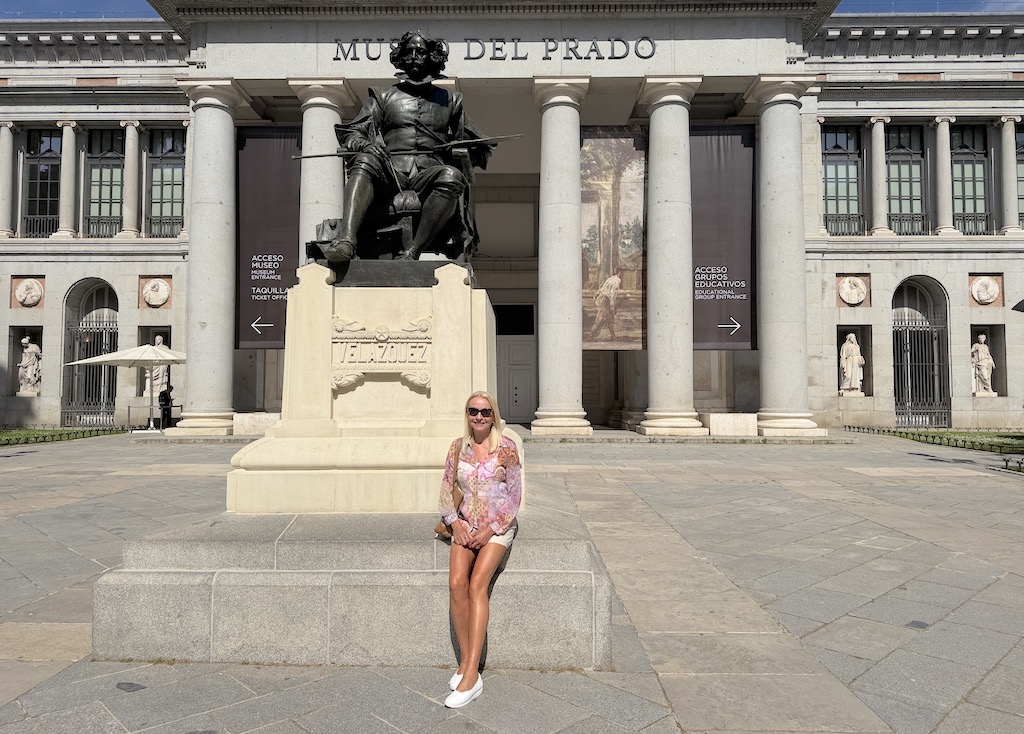
To get a feel for the city’s cultural centre, the convenient Renfe train took us from Pozuelo directly into Madrid’s huge Atacho Station. Against expectation, we were able to go straight into Museo del Prado: the people we’d seen queuing were waiting for the free entry option at 6pm, two hours before closing time.

Museo del Prado
Rather than having to book ahead and be sure to arrive on time, as is the case with many major attractions, I loved how easy our Madrid sightseeing was. It’s probably different in July, though. (You could check here.) They even let us pay the bargain half-price fee of just €7.50 each, and without any time restriction.

You’re not allowed to take photos at all, as I discovered too late. But honestly, in an age when everyone is constantly using a smart phone, do they really expect no pictures to be taken?
Anyway, having flagrantly flouted the law, it now seems only fair to share… if only to make us all feel a little better about any muffin tops or other wobbly bits that may have crept up uninvited.

Amid all this glorious Renaissance art, I particularly liked this portrait of Saint Onophrius being fed by crows, or possibly ravens. Not quite sure why this depiction of a fifth-century hermit touched me; maybe it was the vulnerability of his wrinkly knees. (Mind you, wandering in the desert of Thebes for 70 years would wrinkle anyone’s knees.)
Madrid and Toledo Itinerary: Gin culture
Roy spotted this Bar Museo pavement café, right next to the Radisson Blu hotel. After a caña each (a little beer), our huge G&T Tanquerays, poured at the table and at least four shots, cost just €7. Here in Perth, you’d pay the equivalent for a single shot, and then extra for the mixer. Schweppes is everywhere, by the way. And so is gin, yay! … G&T culture is big in Spain.

Madrid Shopping
Pozuelo, as I mentioned, is a pleasant residential area, the perfect base for a Madrid and Toledo itinerary. It’s about half an hour by train from central Madrid, and our two-bedroom apartment was just 100 metres from the Pozuelo train station. More logistics: it cost just over €14 for a 10-journey travel card that we were able to share – what great value!

From Atocha Station, it’s about a 20-minute walk up Calle de Atocha and via the magnificent Puerta del Sol square to Gran Via, the main Madrid shopping street.
To my gran sorrow, the iconic Zara was undergoing some sort of state of emergency – the gates were locked, and the security man did not know when they would open again. Never mind. Right next door is a flagship Primark, covering an incredible five floors, where I found some sedate black silk pyjamas.
Madrid Shopping: The great Panama pursuit
However, it wasn’t my birthday, was it? Roy’s current Panama hat having recently been (a) squirted with prawn guts, and (b) shat on by a bird, it was time to replace it. Fortunately, in the neighbourhood of Gran Via were no less than three hat shops, or sombrerías, and all in close proximity.
Note: Locals don’t generally wear summer hats, but tourists do – and so there’s a good market for Panamas here and plenty of choice.


First stop: Sombrerería Medrano
From the challenging shape of Roy’s head so clearly visible in the photo above, you can see why he might struggle to find a hat to fit.
Second stop: Casa Yustas (on Plaza Mayor) was second – such a big store and with so many hats! It seemed unfeasible that even the muy quisadillo (choosy, fussy) Roy would not find a suitable Panama. But that’s what happened.
 Third stop: La Favorita (also on Plaza Mayor) was his last chance, and it came up trumps. To my great relief – I’d been feeling very guilty! – Roy had his birthday hat.
-

Third time lucky – Roy gets his birthday Panama hat at La Favorita, Plaza Mayor, Madrid
The obvious question
So, what became of the old Panama hat, birdshit-soiled and soaked with prawn-juice? You might reasonably suppose that it was left behind in Spain. But no. It accompanied us throughout the rest of our Spanish trip, sometimes being worn on my or Roy’s head underneath the new one: especially in airports, for example. And now it sits on a wardrobe shelf with the rest of Roy’s venerable collection of headgear.
[* For anyone who may think that Roy actually has a pointy head, he wants me to completely ruin the joke by explaining that it’s just an effect of the wide camera lens.]
Birthday Lunch
Close to the hat shops on Plaza Mayor, at number 33, we found the elegant and tranquil El Soportal.

Unlike Barcelona and especially Dénia, the habit of serving aioli with your bread-basket doesn’t seem to be a thing in Madrid. That’s sad in a way, but possibly a good thing for the afore-mentioned muffin-top situation. (To see my ode to aioli in the previous post, 7 Days in Dénia, Part Two of this Spanish Road Trip series, click here.)

This was a lovely birthday meal – and, having arrived around 2.30pm, we seem to be getting into the Spanish tradition of lunching late. After a glass of festive cava, I was itching to try a local speciality – aubergines (eggplants, brinjals) drizzled with honey. Fried tempura-style in strips, it was gorgeous. Roy had some excellent steak tartare, and I had the crispy suckling pig. All so good!

There’s plenty of interest in Madrid. We could have spent much longer there. Take for example this restaurant that we passed, founded in 1827:


Toledo Day Trip
They describe Toledo as a day trip from Madrid, and that’s a good way to do it. Half-a-day, or a few hours, was enough for us. And I’m glad we didn’t try to pop into Toledo on the way to our next destination, Córdoba. We would have given up either at the full parking garage (Parking Indigo at Miradero Plaza) or when we found the elevators up to the old town not working … with nothing to inform tourists that there were escalators, too.


Toledo Day Trip souvenirs
My parents visited Spain in 1971, and – unusually for them – brought back several souvenirs of their own Madrid and Toledo itinerary.

At least they spared us a full suit of armour like the one above, though Toledo was no doubt full of them 50 years ago, too. But I do remember a full-sized Toledo sword hanging on our dining room wall; an oversized wooden rosary (actually, that might have been from Italy); and two pairs of castanets for my sister and me.

Half-a-day in Toledo
Picturesque as it is, Toledo felt the most touristy and crowded of the places we’ve visited so far – but it is very different from Madrid, Barcelona or Dénia and is well worth seeing. It’s more like what you might imagine when you think of old Spain: narrow, cobbled alleyways and such.


Toledo Cathedral
Of course the cathedral is spectacular. A vast and monumental 13th-century high-Gothic structure, it was built over two centuries on the site of a former Visigothic basilica and a mosque. Though starting to show the early signs of cathedral burnout, Roy (an ex-chorister himself) said he especially liked the choir with its individually carved chairs.

Toledo Synagogue
Seeing this sign on a door, we went in to see an approximately 18-minute film on Toledo’s history. It’s interesting how they gloss over the persecution of Jews – and especially so when our next stop was Toledo’s fabulous Synagogue.

What happened in 1492?
Toledo was a historic hub of Jewish life where Muslim, Christian and Jewish communities had peacefully co-existed for some eleven centuries, since Roman times. The expulsion of the Jews in 1492 resulted from the Alhambra Decree issued by King Ferdinand and Queen Isabella of Spain. Given just four months to leave or convert to Catholicism, it caused social and economic chaos. Hundreds of thousands of Jews were affected. An estimated 175,000 Jews fled the country.
What if they converted?
Conversion to Christianity was not much protection. Begun in 1478, the Inquisition aggressively monitored the new converts for any sign of Jewish practice. Infringements like lighting candles on a Friday, or being seen to avoid pork, for example, could lead to arrest, torture, confiscation of property and execution, sometimes burning at the stake in public ceremonies.
It was enough to put me off my lunch. Almost.
Lunch in Toledo
Lunchtime found us dining alfresco in the historic centre of Toledo. We found a table on the so-called street terrace at Restaurante Placido at Calle Santo Tomé 2. Housed in the former Convent of San Bernadino, it has an atmospheric interior that in retrospect might have been a better choice.


We had the menu del dia: gazpacho and pork cheeks for me; tuna salad and carcamusas (stew of pork, chorizo etc.) for Roy; €25 a head. Verdict? Something of a tourist trap, but then so is much of Toledo.


So much for Madrid. Though we could have spent more time here, this felt like a satisfactory introduction to the city.
El Santo Reserve
The freelance writing and editing work* that I have done for El Santo Reserve, a unique property just 40 minutes’ drive from Madrid, should have prepared me. Still, I was blown away by the magnificence of the place – from its 14th-century architectural historicity to the sweeping natural beauty of the surrounding 1,058-hectare estate.
(*I work through my sole proprietorship, Write First Time, which I established in 2000. My email is verne.maree@gmail.com.)

For the past two years, El Santo Reserve has been owned by a chap called Tim Hartnoll, whose other properties include the high private island resort Bawah Reserve (Indonesia) and a couple of interesting waterfront hotels in the UK. (The Relais Henley is mentioned in this blog post of mine from two years ago.)


El Santo Reserve – palace tour
Happily for us, my client Kristen happened to be on site, and it was lovely to see her again and have her show us around. We also met the property manager, Elena, a charming Madrilañesa.

Each of the palatial seven bedrooms in the main building is furnished differently according to its own distinctive theme. There are also two other gorgeous private apartments, each with two double bedrooms.


Though not yet open to the public – we hope that will happen soon! – Kristen, Elena and team are working on perfecting the already impressive facilities.
This indescribably evocative and authentic medieval cellar still features its original wine casks.
Historical note: Not only were the resident monks catering for their own needs, but as a recreational and agricultural estate (or granja, meaning farm) belonging to the Hieronymite Order, they also provided wine, wood, meat, fruit, vegetables and more to monks at the massive San Lorenzo del Escorial Monastery. (See the timeline below.) El Santo Palace was also a nice getaway for the hard-praying monks from the Monastery, and sometimes even hosted royalty and other high-ranking visitors.

When it does open for reservations, it will be only for exclusive buyout. They have a similar arrangement for hiring out Elang Private Island at Bawah Reserve. (Find out more about that at this link.) In other words, you would have to book the entire El Santo Reserve for your conference, hunting party, wedding or other special occasion.

Apart from giving us a knowledgable tour and a potted history of El Santo Reserve, Elena capably steered the Defender around part of the 1,100-hectare estate to give us an idea of its hiking, hunting and other potential.
We are so lucky to have been able to include El Santo Reserve in our Madrid and Toledo itinerary.
El Santo Reserve – a potted history
Speaking of potted history, here’s a timeline of El Santo Reserve’s history, based on the contents of a coffee table book that Kristen asked me to edit a couple of years ago.
Briefly, El Santo is one of only a few historic estates linked to the Spanish monarchy that has come under private ownership. It was used since the Middle Ages as a big game hunting reserve (wild boars, and even bears), and subsequently as an agricultural and livestock farm belonging to the religious Order of the Hieronymites. It was the powerful monarch King Phillip II who integrated it with his favourite project, San Lorenzo del Escorial Monastery.

Timeline: History of Occupation, Ownership, and Use of El Santo
- 14th Century: First recorded as Sanct Sadornín, a hermitage and royal hunting ground, mentioned in Alfonso XI’s “Libro de la Montería”.
- Late 13th–16th Centuries: Owned by the Order of the Hieronymites, serving as a monastic farm and retreat.
- 1566: Purchased by King Philip II, integrated into the Monastery of San Lorenzo de El Escorial. Used for Renaissance agriculture, royal leisure, and monastic recreation.
- 17th Century: Renovated by Philip III and Philip IV; continued as a productive estate and royal retreat.
- 1700s: Under Bourbon rule, the estate’s use as a royal retreat declined; focus shifted to agricultural production.
- 19th Century: Suffered neglect during Napoleonic occupation and secularisation. Auctioned after the disentailment of church and crown lands (1869).
- Late 19th–20th Centuries: Acquired by General Martínez Campos; restored and modernised, becoming a private estate and social venue.
- 21st Century: Remains privately owned, preserving its historical and architectural legacy.
Lunch at Chapinería
El Santo Reserve is located between three municipalities: Aldea del Fresno, Navas del Rey and Chapinería.
Elena recommended lunch at El Ventorro in Calle del Colmenar 2 in Chapinería, and phoned ahead for us. Charmingly, the patron got his English-speaking daughter on the line to discuss the menu with us.

It was great: we shared a plateful of grilled squid (chipirones a la plancha) in garlic and parsley, and a salad with duck jamon and candied egg yolk – deliciously strange.


Love this Spain trip blog, Verne! You had such an awesome trip.