
Cruise to Hawaii; Aliens, like me: immigration frustration in Hilo; walking it off; Michener’s Hawaii; Hilo Highlights tour; 3 days in Oahu; shopping Honolulu’s Ala Moana; ghastly strawberry guava jam and other sugary low-lights; Round the Island coach tour of O’ahu; upscale local fare at Fete in Honolulu’s Chinatown; walking to Waikiki, wow!; seen around the ship
Our first stop in the Americas! Fun fact: Hawaii is the 50th state – the 49th being Alaska and the 48th Arizona.
Cruise to Hawaii with aliens like me
Clearing immigration into the States was a most annoying exercise, as it turned out that physical visa-holders like me (only a handful of us on board, it seemed) did need an I-94 form, without which the officials declared we couldn’t be processed. (Non-pariahs like Roy, all of whom were on the e-visa system, simply filled in the visa-waiver form.)
Eventually, a clever woman with an even cleverer smartphone was apparently able to call up the entire USA immigration admin system, match my new visa photo to their records – which included a previous 10-year US visa that expired eight or nine years ago – and let me off the ship and into the country.

Hilo Walk
All this having happened quite swiftly, I found myself with a two-hour gap before the Hilo tour we’d booked. So I went off to see what I could see. (Darkly warned by Roy not to be back late.)
Where is Hilo?
The city of Hilo is on the eastern coast of Hawaii’s Big Island. Also called Hawai’i, the island is famous for its volcanoes, most notably Mauna Kea, the world’s biggest active volcano.

And here’s the bigger picture, for the sake of context:

What I saw


After trundling along in the direction of downtown Hilo for 20 or 25 minutes, initially through a light-industrial neighbourhood, I veered off to the waterfront down Banyan Drive. Here I found a handful of hotels – including a Double Tree by Hilton, and lovely views over the water and of the Westerdam… and, of course, dozens of impressive banyan trees, each accompanied by a sign with the name of whoever planted them, along with the date (1930s, mainly).


Lili’uokalinu Gardens
Roy was not pleased that I’d stumbled by accident upon Lili’uokalinu Gardens, as it was scheduled to be the first stop of today’s tour. (“You can sleep through that part of the tour, then, said he bitterly.) As it turned out, the tour bus didn’t stop here but merely drove around the perimeter.
So here are a couple of pics of this pretty park with its Japanese-style bridges, sculptures and volcanic rocky outcrops, said to be dedicated to the island’s Japanese immigrants.
____________________________________
Michener’s Hawaii
At least 40 years had passed since I first read James A. Michener’s 1,500-page novel, Hawaii. Roy had just re-read it in preparation for this cruise – of which our three-day stay in Hawaii was the highlight, as we’d already visited most of the South Pacific Islands on a previous cruise.
He shared his Kindle version with me. However, in-between sightseeing the afore-mentioned islands, negotiating onboard cocktail hours and mealtimes on the Westerdam, jogs around the Promenade deck and minor bouts of seasickness, I was still only halfway through Hawaii (the novel) as we approached Hawaii (the 50th state of the USA).

Of volcanoes, whalers, traders, missionaries and migrants
Four decades later, I remembered little of Michener’s great work. It starts by detailing the volcanic activity that began about 70 million years ago to create the chain of Hawaiian islands, made up today of 15 volcanoes. It traces the history of the first indigenous people, said to have made the incredible journey from Bora Bora; and later the mainly 19th century explorers, whalers, traders and American missionaries, who brought with them an unholy devastation of the indigenous population – largely through diseases like measles, syphilis and smallpox – from an estimated 300,000 or more souls to fewer than 40,000 by 1890.
Waves of Chinese and Japanese immigration also play an important part in the history of Hawaii, said to be one of the most multi-racial of all American states. Hawaiians also have the longest average lifespan in the country… despite their passion for Spam, which seems to rival coconuts for the honour of being Hawaii’s favourite comestible.

__________________________________________
Cruise to Hawaii: Hilo Highlights Tour
After the disappointing tour at our last port, Pago Pago (American Samoa), we were much pleased with today’s four-hour Hilo Highlights tour – and especially with our guide and driver, Maggie, a Taiwanese woman who has been in Hawaii for 33 years. Having just 20 people on the bus meant that unloading her charges each time we stopped didn’t take too long. And she kept up a useful and edifying commentary on what we were seeing, together with a string of strict injunctions to be back on the bus on time.

After circumnavigating Lili’uokalinu Gardens – and with the state of decrepitude of some of our fellow-passengers, it was probably a good thing not to have stopped there – the first actual stop was the Mauna Lao macadamia nut factory. You get there through a couple of kilometres of orchards – papaya on the left, and macadamias on the right.

With 250,000 trees, this is the world’s biggest macadamia nut farm, said Maggie. The macadamia also the world’s hardest nut to crack. And one of the most nutritious and delicious, in my opinion. We bought a few packets in the shop, of course – and later found them to be quite easily available in Canada and the US, too. (In fact, as I write this I’m munching my sugar-laden way through a punnet of Hawaiian crystallised ginger that I bought in a Washington State grocery store.)
Driving through downtown Hilo, Maggie pointed out two rocks in front of the town library – the larger one said to weigh 5,000 kg (or was that pounds?), and said to have been lifted by the great King Kamehameha, the first monarch, who lived in the 18th century. We would stop later to take a photo of his statue.
But first, the all-important Farmers Market in downtown Hilo, where I splashed out on a US$5 green coconut. Then we browsed the small high street and its collection of touristy shops. Maggie explained that this side of the island has only a few hotels, but Kona, on the other side, has at least 60 hotels and a few upmarket designer shops.
Rainbow Falls
Of the many waterfalls the island is famous for, this is said to be the most accessible. Sorry, no rainbow today; for that, the sun needs to be cooperating. You can climb up a path for a different view, while trying not to step on children.
Black sandy beach
I’m not sure what we’re doing here – black sand is no one’s favourite – but here’s a picture of a blackish sandy beach, complete with blackish pebbles. And Roy, surveying canoes on the adjacent grassy patch.
Big Island Candy
Nice Easter display at this upmarket confectionery shop, just in time for the Easter weekend – it’s Good Friday tomorrow. (We’d be seeing a Big Island Candy at Ala Moana Center in Honolulu, too.) But weirdly, we saw not one actual Easter egg anywhere in Hawaii.
_________________________________________________________-
Three Days in Honolulu, O’ahu
With three days and two nights berthed in Honolulu harbour, O’ahu island, we had plenty of time to explore at our leisure.


First things first: a coffee at Local Joe’s in Marin Street, Chinatown – five minutes from the Westerdam’s convenient mooring at Pier 11. Now ready for a spot of shopping, we easily called a $9 Uber to convey us to one of the world’s biggest “open air” shopping centres, Ala Moana. (How annoyed Roy was when the return taxi in the busy mid-afternoon cost a whopping $23! So irate that he actually walked the entire distance the next day; see below.)


Ala Moana Center
One of the world’s biggest open air shopping centres, Ala Moana is a destination in itself. It has all the American and international brands you can think of, and then some.


Lunch at Liliha Bakery, Ala Moana
By now, it was lunchtime. Not only a bakery, busy Liliha at Ala Moana served us excellent Denver omelets, crammed with cheese, bacon and veggies. (To be honest, this was not so much cheese as a highly processed cheese-like substance that repeated on me for a good six or more hours.)

We’re trying to be good, right? But what’s in this basket of iniquity? They come with every meal, we were told: butter-fried rolls (admittedly soft, fresh and generally delightful) served with an unspeakably synthetic red syrup (unreservedly yuck). This red gloop goes by the name of strawberry guava jam and its daily consumption is guaranteed to bring on Type 2 diabetes within 10 days.

_________________________________________________________________
Cruising to Hawaii: Round the Island Coach Tour, O’ahu
This turned out to be a great way to see quite a lot of O’ahu in a single day, and our local guide/driver, Lee, did an excellent job.

Snippets from tour guide Lee
Lee grew up in Lahaina in the 70s and 80s; the area was devastated by fire a few years ago.
While driving along Kalakaūa Avenue, a long shopping stretch that felt and looked a bit like Orchard Road complete with high-end shops such as Rolex, Dolce & Gabanna and the rest, plus the lovely lovely Moana Surfrider Hotel, he kept up the commentary.

This is the only island with a freeway system – H1, H2 and H3. And if you go too far, he quipped, you hit the H20, which is what you cruise passengers came in on. Hehehe.

- This island, O’ahu, houses two thirds of Hawaii’s population – which is currently down to 1.44 million. 249,000 people live in the city of Honolulu.
- A top-floor penthouse at Ala Moana Center, right next to Waikiki Beach, was sold a few years ago for US$20-odd million. No wonder they keep on building new million-dollar apartment blocks.
- The Merrie Monarch festival, named after Hawaii’s last monarch, king David Kalakaua (1874-1891), celebrates all things Polynesian culture.
- Spam Jam is a festival that celebrates the tinned luncheon meat Spam, even crowning a Mr and Mrs Spam. Even McDonald’s serves Spam here. There are at least 30 different flavours of Spam, including a Pumpkin Spice version. What were they thinking?
- Unlike the rest of Oahu’s naturally white beaches, Waikiki Beach is artificially covered with sand that was imported in the 1990s from San Diego, California.
- Most people in Hawaii need to work multiple jobs just to get by, because the cost of living is so high. And even on a short visit like this one, you can tell that it really is.
Continuing along the Kamehameha Highway, we pass Coco Head and Coco Crater – not quite volcanoes, but rather “cylinder heads” that generate enough underground pressure to create hills like these.

#1 First stop is a coastal lookout with some spectacular blowhole action through the volcanic rock – and a path down to a gorgeous little beach that I only saw too late.

The southern coastline of O’ahu is its dry side, featuring volcanic rock formations and spectacular views. Says our guide: If you fish, hike or swim here here and something happens to you, do not try to sue the state: we are big proponents of natural selection.
Then comes Sandy Beach, which locals call Broken Neck or Broken Back beach for the 40-50 feet waves that sometimes crash right on to the sand.
#2 Second stop is the Pali mountain lookout.

#3 Third stop is a Buddhist temple, adjacent to a large cemetery divided into Protestant and Buddhist areas; there is also a pet cemetery where plots go for around $5K, Lee tells us. Signs advertise “ocean view” burial plots. Seriously.
Built in the 1960s to celebrate 100 years of Japanese influence, Byodo-In temple is a replica of the famous Byōdō-in temple near Kyoto, Japan.
We are winding up to the North Shore that is so famous for its sets of waves measuring over 60 feet, and especially for Hawaiian surfer Eddie Aikau. Commercial vehicles such as tour buses are sadly (but I suppose sensibly) forbidden by State law from stopping at any of these beaches, the most famous surf spots being Waimea Bay, Sunset Beach and Banzai Pipeline (Ekuhai Beach Park).
#4 Fourth stop is Hale’iwa, a North Shore surfing town and tourist destination. Greatly delayed by heavy traffic, it was 2.15pm before we eventually got here for our lunch stop. With masses of options to choose from, Roy and I had a fabulous poke plate at Poke No.7, then a coffee at Island Vintage Coffee – the same chain as provided us with coffee yesterday at Ala Moana.

The long queue seems to be an ongoing feature of Matsumoto’s Shave Ice in Hale’iwa. Shave ice is the Hawaiian counterpart to ice kachang/kacang in Singapore and Malaysia: a ball of crushed ice liberally decorated with all sorts of colourful and generally synthetic shite. The place is clearly an institution, however, complete with plenty of souvenirs for sale.
#5 Fifth and final stop is Dole Plantation, the home of the pineapple: nay, a virtual pineapple theme park, where anyone who held back from the sugary shave ice at Matsumoto’s in North Shore can change his or her mind.
So, having turned up our joint noses at the shave ice in Hale’iwa, North Shore, we found room for the brain-freezing Dole Whip – pineapple sorbet. I’m still regretting it.

_________________________________________________________________
Review: Fete, Honolulu Chinatown
Less than a nine-minute walk from the ship’s berth, Fete had been recommended by a West Australian newspaper journalist – I use the term journalist loosely here, considering the pitifully low standards of this parochial rag – who was clearly hosted at Fete as part of a jolly organised by the Hawaiian Tourism Board. I’ve been on many such jollies in my career, and there’s no doubt that being hosted tends to lower ones critical faculties.

That said, we loved the look and feel of the restaurant, whose award-winning chef does a generally great job with her farm-to-table menu. Our starters were perfect: vitello tonnato for Roy, generously heaped with salad; and cioppino for me, featuring mainly two large prawns in a tomato-based soup based on a house-made crustacean broth, with aioli-topped sourdough bread.
Roy’s main of pork chop was excellent, too – just not hot enough, even when sent back. That was enough to spoil it for him. (Happily, the dish was taken off our bill.) As for my main, I simply ordered the wrong thing: double-fried chicken. Somehow, this being Hawaii, and the touching story of the chicken farmer working with research people to develop a chicken-feed based on macadamia nuts, made me think I might like this version of deep-fried chicken. I was wrong. The sweet and fruity sauce didn’t help – probably authentically Hawaiian, but not to my taste.

What we did both like was the dessert – an unmissable frozen confection based on taro (the local root vegetable) steeped in coconut milk and laced with blackstrap (molasses) rum. I stayed full for a very long time, possibly days. Price? With a bottle of French Loire Valley sav-blanc/chardonnay, and minus Roy’s main, about US$200. (Plus 20% tip, now that we’re in the USA.)
__________________________________________
Walking to Waikiki
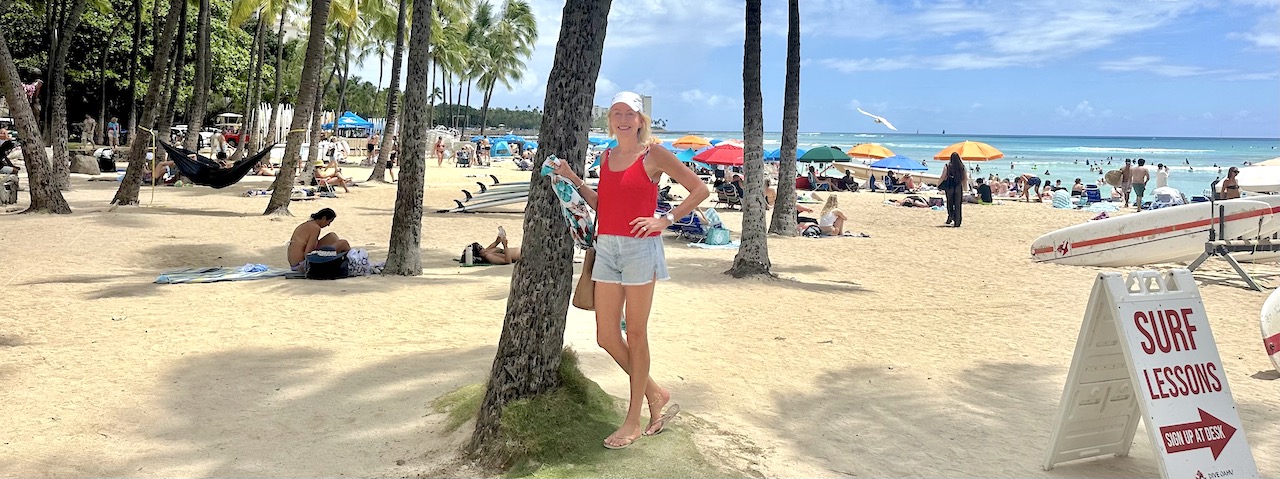
I have mentioned that Roy was annoyed by that $23 taxi fare for the short trip back to port from our shopping trip to Al Moana. But I never expected him to walk with me all the way to Waikiki Beach – so long and so far that I had to buy a sarong halfway to protect my shoulders from the sun.


Finally at Waikiki Beach, and the photo below of the banyan tree and the Chevy Impala is Roy’s favourite; he literally snatched my phone from me and took it himself. Good job, hey?

Thanks, Hawaii! We had a lot of fun.
_____________________________________________________
Final Days at Sea
Finally, five days at sea would bring us to our disembarkation point at Vancouver, British Columbia, Canada.
Let’s finish with a few pics from the Westerdam.
Out on deck


Wining, dining and dancing


The phenomenal band from the Rolling Stones Lounge
Working it off


_____________________________________________
Next Up
Vancouver, Canada!


[…] process in Victoria, British Columbia, Canada. We’d been extensively coddled during our 28-day cruise from Sydney; now we were going to be looked after by my cousin, Bradley, and his wife Ingrid, South Africans […]