
Córdoba and Seville road trip; one night in Córdoba; bleh B&B, perfect parking; Córdoba’s magnificent Mosque-Cathedral; 8th-century hypo-style mosque hall; 17th-century Renaissance cathedral; flamenco at El Pañuelo; running Córdoba: the irresistible Rïo Guadalquivir, the Puente Romana bridge and the romantic Roman Gate; a whole lot of bull on the way to Seville; perillous parking, delightful digs; el scorchio temperatures but Spanish brain freeze; Seville Cathedral and Reál Alcázar, closed on Sundays; trotting the Guadalquivir… again; El Burladero, Christina’s Bistro, Bar Alfalfa; what’s with the girly drinks, Roy?; Next up: Cadiz and Tarifa!

Cordoba & Seville Road Trip:
One night in Córdoba
For a Córdoba and Seville road trip, one night in Córdoba wasn’t really long enough – one night isn’t not long enough almost anywhere, agreed? (Except maybe Portland OR*, enough to make a hard man humble). But with our accommodation being so central, it worked out fine.
There are plenty of things to do in Córdoba that we missed on this Andalusia road trip. That said, at least we got to see the fabulous Mezquita-Catédral (Mosque-Cathedral) and some authentic flamenco.
We almost didn’t get to Córdoba at all, and that would have been a shame. We had feared that the recommended Indigo Parking Garage would be full, and that would have been awkward to say the least. Because the next day was the start of the week-long Fería de Córdoba (Córdoba Fair), you couldn’t book parking in advance. But we successfully got around that by arriving reasonably early, before the parking garage had filled up.
(*Click here for a rabbit-hole side-trip to our Canada and US road trip in May 2025, and scroll down to Desolation in Downtown Oregon. Remember to come back here!)
On the way to Córdoba
Arriving in good time doesn’t mean skimping on coffee, of course. This place didn’t look particularly promising from the outside, but it had lots of character. More importantly, it had the all-essential loo and it served good coffee. If we’d wanted lunch, this selection looked yummy.


Staying in Córdoba
Apart from its great location, the street-level apartment at 13 Paseo de Victoria was below par. Roy mused on who could possibly have rated it “fabulous” on booking.com. It was probably the worst of all our accommodation during the whole of our six-week Spanish road trip.

Córdoba’s Mosque-Cathedral
Córdoba’s Mezquita or Mosque-Cathedral – a UNESCO heritage site – is incredible. Even Roy Seen-one-temple-seen-them-all Titchmarsh was deeply impressed.
Construction of the original mosque was begun in 785 AD, initially by the Umayyad ruler Abd al-Raman 1, on the site of the Visigothic Basilica of San Vincente. His two immediate successors added to and developed it over the next century or so.


You enter through a delightful courtyard full of orange trees – El Patio de los Aronjos.

Hypo-style mosque hall
Uniquely, unlike various other cathedrals built on the site of former mosques, which themselves topped Roman foundations or Visigoth basilicas, this cathedral was literally built within the mosque structure: an enormous hypo-style hall containing a “forest” of 856 columns in marble, jasper and onyx topped by double-tiered red-and-white arches.


Cathedral scenes
After the Christian Reconquista, the mosque was consecrated as a cathedral in 1236. A Renaissance nave was inserted within its central prayer hall in the 16th century.

Córdoba Itinerary: Flamenco at El Pañuelo
Yes, Roy and I attended one or two flamenco dancing shows in my home-town, Durban: but that was ages ago, well before the turn of the millennium. He remembers these performances better than I do, having seen his shipping company lawyer divested of her usual dark business suit and transformed into an extravagantly colourful and foot-stompingly passionate flamenco artiste. He still talks about it.
But this was our first real flamenco experience: dinner and a show at intimate flamenco joint El Pañuelo. (El pańuelo means the scarf, or the handkerchief.)

We had front-row seats, next to a table of around 16 women (all gorgeous) doing something like a hen’s party. Beautiful Sophia introduced herself: a literary translation professor born in Toledo, married to a Canadian and now living in Utah, she was here for the summer and her friend’s upcoming marriage. None of the others spoke fluent English, she explained.
Running Córdoba
Next morning, my run took me back past Córdoba’s Mosque-Cathedral, possibly even more beautiful in the early light. From there, it wasn’t far to the broad and lovely Río Guadalquivir. Guarding over one side of the Roman bridge, Puenta Romana, is the spectacular Roman Gate.

Córdoba and Seville Road Trip: 2 Nights in Seville
It takes about an hour-and-a-half to drive from Córdoba to Seville, where the city was sweltering in 35-degree heat (90 degrees Fahrenheit).

Staying in Seville
I don’t know how Roy does it. The Skoda station wagon isn’t a small car, and on this Córdoba and Seville road trip I find myself shamefully having to shut my eyes while he’s squeezing us through yet another impossibly small lane.
The parking for guests of Abreu Suites, Seville was a case in point: the host met us in the street, literally stopped the traffic, and opened the garage doors to let us in. (She had not been able to confirm ahead of time that there’d be a spot available for us.)

Then there was an intricate set of instructions about ingress, egress, and how and where to drop off the keys on departure. I’m supposed to be the one with basic Duolingo Spanish, but at moments like these it’s as if my brain freezes.
The beautifully furnished Abreu Suites was a real find for our Córdoba and Seville road trip. (Here is a link.) We had a lovely two-bedroom and two-bathroom suite, though it lacked a washing machine. For that, there’s a laundry room on the third floor, along with a rooftop pool, loungers and seating in a nice little patio garden.
Sightseeing in Seville
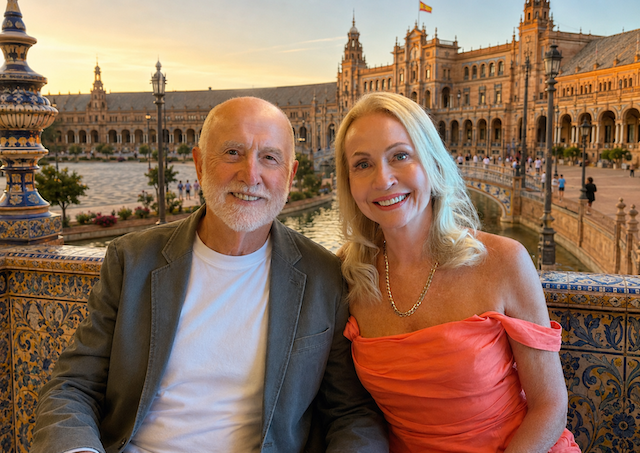
Have I mentioned that it was roasting? Figuring that it might cool down a bit after sunset (about 9pm), we took an Uber to Plaza de España. This fanciful monument was especially designed and constructed for the 1929 Ibero-American Exhibition World Fair, and has become synonymous with sightseeing in Seville.

On this particular Spanish road trip, I didn’t get to ride in one of these horse-drawn carriages, which I remember doing when I first visited Seville back in 1989, or was it 1990? Never mind… it was a long time ago. (You can read a bit more about that arduous solo experience if you click here for my Spanish Road Trip Prologue and scroll down to Portugal and Spain 1989.)
Riding in a horse-drawn carriage still ranks among the best things to do in Seville. These picturesque carriages have been operating in Seville since the 16th century, and by the 1800s had become the main mode of transport for all Seville citizens. Imagine that! It was nice to see that they’re still doing business.

Sunday trot in Seville
That second morning, trying to get ahead of the heat of the day, I pulled on some running kit and set off to discover Seville on foot.
It was Sunday, so not much would be open today. But here’s the famous cathedral – aren’t they all? – and the Royal Alcázar just around the corner. They say that Seville’s Royal Alcázar is fabulous; one or more scenes of the fifth season of Game of Thrones were shot there.


Having evolved from the Moorish fortress constructed in 913AD (once again, using materials from earlier Roman and Visigoth structures), Seville’s Royal Alcázar is the oldest palace in Europe still in use today. It remains an official residence of the Spanish monarch.

These orange trees next to the cathedral and the Alcázar are sheltering what appear to be tourists waiting for their 9am tour guides. Orange trees are everywhere, and I’d love to be here for the three-week orange blossom season in late February and early March.

Guadalquivir River and Triana
This is of course the same wide and lovely waterway that I’d already seen in Córdoba and is described above. Long, wide promenades make it a great area for walking and jogging.

Several bridges span the Guadalquivir to link the old town of Seville with the lively Triana neighbourhood. I crossed the river at Puente San Telmo and followed Calle Betis before returning over Puente Isabel II.
This interesting-looking market – Mercado Lonya del Baranjo (below) – was closed, like much of the city on a Sunday. (Note: If you have just one day for sight-seeing in Seville, let it not be a Sunday.)

Where the bridge (Puente Isabel II) starts, there’s this a cute castle. In fact, it’s an interpretation centre for the underground ruins of a medieval fortress called Castillo San Jorge, which served from 1485 to 1785 as headquarters of the Spanish Inquisition. The original fortress was demolished in the early 19th century to make way for the Triana Market.

Eating in Seville
Lunch at El Burladero, Hotel Colón Gran Meliá
Lunch soon after arrival in Seville was on a shady pavement outside the refined El Burladero, just around the corner from Abreu Suites. It’s part of the five-star Hotel Colón Gran Meliá. Best Spanish salad (egg, potato) ever; croquetas, and prawn-topped baked artichoke awash in delicious olive oil.
Christina Bistro for dinner
From Plaza de España, it was an easy walk to Christina Bistro (Calle de San Fernando) for dinner.

Salad of Los Palacios tomatoes, from an acclaimed agricultural area that we’d be passing through on our way to Cádiz – Los Palacios y Villafranca. For any salivating vegetarian friends out there, be aware that those white bits are pork fat. And this lovely, fresh tuna tartare is on a bed of mashed potatoes. Less successful was the lingote de rabo de ternera: I prefer my oxtail more-or-less attached to the bone, rather than pulled off and fussily re-assembled liked this.
Bar Alfalfa
The tiny Alfalfa Bar, in Calle Alfalfa in the old city’s Alfalfa neighbourhood (you get the idea), was for us the culinary highlight of Seville.

Nearly halfway into our six-week Spanish road trip, it may sound strange that this was our first meal of tapas in a tapas bar. Luckily, our timing was good. When the seats are all taken, they close the door and you wait outside. (No, I would not have waited outside.)
Not us! From behind his counter, the “can-do” proprietor beckoned us in to take the last two seats at the bar. We had the best view of the action as the small team – Caña-man, his wife and just one other guy in the kitchen – worked flat out until the last octopus tentacle (pulpo) had been char-grilled, popped onto a bed of parmentiére and gratefully slurped down.


Apart from pulpo, we also shared a tapa of yummy paella; a plato (bigger than a tapa) of smoked salmon on toast; and a gratuitous wedge of lasagne. A couple of cañas (small beers) for me, sangría for Roy. Yes, my Roy is getting a bit girly with these sweet, fizzy drinks*.
* Sangría Recipe
Dozens of glasses of sangría were assembled under our noses at the Bar Alfalfa counter. The primary alcoholic ingredient of sangría rojo is a red wine such as Rioja, Tempranillo or Garnacha. They also add chopped fruit and, importantly for the strength and flavour, a generous dash of strong stuff from another bottle. When that was empty, we watched our man refilling it with a mixture of (I think): brandy, orange liqueur, white rum … and maybe sherry?
Semantic note: The name of this wine-based punch from the 18th century, sangría, translates literally from either Spanish or Portuguese to bloodletting, or bleeding.
Next Up?
We head south to our next two destinations, and both on the coast: first Cadíz and then Tarífa. They both have a tremendous sense of place. Though we’ll still be in Andalusía, bristling with Moorish heritage, flamenco and bulls, the wind has picked up and the feel is distinctly different from both Còrdoba and Seville… as you’ll see!


