
Cartagena and Valencia road trip: two nights in Cartagena and three days in Valencia made for a memorable final leg of our five weeks in Spain. Between Cartagena’s Roman history, Valencia’s atmospheric Old City and the distinctive culinary treasures of both, these two cities became unexpected highlights of our self-tailored* journey.
Ode to my Travel Agent
When I call this Cartagena and Valencia road trip self-tailored*, of course I mean Roy-tailored. As my inestimable travel agent, he makes sure to consult, confer and so on. But if we’re being honest, he’s in the driver’s seat… this time both literally and figuratively. Does that work for someone as bossy as me? Oh, yes. If anything goes wrong – as it rarely does – he knows that he is to blame and will be energetically motivated to fix it.
All this leaves me as a blogger free to explore the meaning of life, to reflect on the mind-expanding benefits of travel, and to seek out the next gin and tonic on this Spain road trip itinerary.

2 NIGHTS IN CARTAGENA
After five nights with my sister Dale and her family in Nerja (see Part 6, Málaga and Nerja), we’re making our way back to Barcelona (see Part 1) via two nights in Cartagena and three nights in Valencia.

Favourite stop
It’s around 360km from Nerja to Cartagena – the ancient Mediterranean port in the southeastern Spanish province of Murcia, founded by the Carthaginians in 227 BC. Its name comes from Qardt Hadasht (“New City”), and it’s described as “one of Spain’s most underrated historic cities, with layers of Phoenician, Carthaginian, Roman, Byzantine and naval history”.
We fully agree. Though we had only two nights, Cartagena was one of our favourite stops on this entire five-week Spanish road trip itinerary.

Modernist Architecture in Cartagena
On this Cartagena and Valencia road trip, we found Cartagena unexpectedly stunning, and even more so because of its walkability and manageable size.
Cartagena’s glorious architecture reflects its layered history: Roman archaeology, imposing military and naval structures, neoclassical buildings and a wonderful collection of ornate Modernista façades dating largely from the mining prosperity of the late 19th and early 20th centuries.


Short History of Cartagena, Spain
(*Skip this at your peril. There will be a test.)
Most of us – except for my ancient-history-erudite friend and ex-colleague Shamus Sillar – have zero-to-hazy knowledge of this era. I had to bone up on it quickly to do Cartagena any sort of justice.
The name Cartagena evolved from its role as a base for Carthaginian expansion from North Africa into the Iberian Peninsula. So, you may be forgiven for wondering, what was Carthage? Founded around 814 BC, Carthage was an ancient Phoenician civilisation and major trading empire based in North Africa (modern-day Tunisia) that dominated the western Mediterranean. It reached its height in the 4th century BC, controlling vast trade networks, extensive colonies, and a formidable navy that ruled the seas from North Africa to the Iberian Peninsula.
Its intense rivalry with Rome culminated in the Punic Wars (264–146 BC). If you remember the story of the audacious Carthaginian general Hannibal Barca and his elephants, that’s part of the Second Punic War (218-201 BC). After a prolonged conflict featuring famous campaigns by Hannibal, the Roman Republic destroyed Carthage in 146 BC. The site was later rebuilt as a Roman city and today is a residential suburb of Tunisia and also a UNESCO World Heritage Site.

Roman Theatre of Cartagena
Back to Cartagena, Spain, where the Roman Theatre of Cartagena is the star attraction. It was discovered only in 1988 beneath the old city, and is said to be one of Spain’s most impressive Roman theatres. You find it at the end of a well-designed museum.

Cartagena Harbour & Naval Heritage
The Roman Theatre is just a hop from the Harbourfront, its waterfront and marina, bristling with naval buildings and monuments. Unfortunately, we were not able to visit either the Museo Naval (Naval Museum) or the National Museum of Underwater Archaeology (highly recommended), because they’re closed on Sundays – and Sunday was our only full day in Cartagena.
During my morning run/walk, I at least got to see these impressive monuments from the outside.


The former Real Club de Regatas de Cartagena (above left) is Cartagena’s original Royal Regatta Club. Designed by local architect Mario Spottorno, it opened in 1912. Check out the theatrical façade, which, we are informed, combines Modernista/Art Nouveau decoration with neobaroque flourishes.
That disturbing sculpture (above right) is El Zulo, by Spanish sculptor Víctor Ochoa. Installed on the harbourfront in 2009, the enormous bronze (about five metres tall) is a memorial to the victims of terrorism.
Arsenal de Cartagena
It seems to go on forever. This historic naval base and shipyard, established in the 18th century, is still an active military base and serves as Spain’s primary naval hub in the Mediterranean.
I smiled at the guard, but he was both heavily armed and clearly disinclined to let me through his magnificent 18th-century neoclassical gateway.
Corpus Christi Procession
At least we got to join all the good people of Cartagena in their 125th Celebration of Corpus Christi, one of the major Catholic festivals of the year. Drumbeats brought us out onto the street, where we followed the only slightly out-of-tune brass band to the church of Santa Maria de Gracia.
Flash in the pan?
If 125 years sounds like a long time, it’s embarrassingly flash-in-the-pan compared with the seven hundred years of Corpus Christi processions claimed by Valencia, as evidenced by the pic I took the very next evening – an enormous and arguably boastful mural. (Scroll way down to Valencia Cathedral to see it). It’s on the façade of the basilica, right next to Valencia Cathedral, located in Plaza de la Virgen in Valencia Old City.
Procession-watching is thirsty work, and somewhere in the world it was cocktail hour. Cheers!

Where to Stay in Cartagena, Spain
I don’t review all the accommodation we’ve been staying in, but our two-bedroom apartment in the old city of Cartagena was probably the best of them all – and certainly a highlight of this Cartagena and Valencia road trip. The address: La Casa de Florentina, Calle de Florentina 16, 30201 Cartagena.
It’s a lovely neighbourhood:
And it’s a wonderful apartment. This 1949-built second-floor gem has been immaculately restored and tastefully decorated – clearly with no expense spared. Owner Xavier met us in the pedestrianised zone as arranged – it’s always hairy to drive where you’re afraid you shouldn’t be driving – to show us around the apartment and point Roy to the parking garage located about 500m away.
Just behind us was this archaeological park, which joins up with the ruins of the old cathedral, and the Roman Amphitheatre. I enjoyed the various murals along the way… a relief from the graffiti that covers Spanish cities and even the countryside.


More Fabulous Murals
It was a good project to create these wonderful murals, discouraging the graffiti that is so ubiquitous throughout Spain.
3 DAYS IN VALENCIA

Valencia Old City Accommodation

Good thing we’d had a bit of practice yesterday driving down a couple of Cartagena’s pedestrianised alleys, heart-in-mouth, to get to the assigned parking. Today’s inner-city route was even longer and more fraught. Once we’d picked up the keys from the reception, however, it was quite doable.
At least the parking was in the basement of the same building, Citizentral Juristas. A stone’s throw from the Cathedral, Plaza Manises (which we actually drove across!), it was also just 200m from a jolly useful Carrefour Market. There we foraged for the six major food groups: baguette, ham, queso de cabra (goat’s cheese), milk, Rioja wine and Nespresso capsules.
Spotted on the way to Carrefour
In the first pic, the large stone building is the 1421 Palau de la Generalitat Valenciana, historic headquarters of the Valencian regional government. The pretty blue-and-cream building is the Palau de la Batlia. Originally a noble palace dating from the 15th-16th centuries, it is now the provincial government headquarters.
As for our well-designed two-bedroom apartment, it had both an en-suite bathroom with tub for me and a shower-room for Roy. Reception staff brought me a bath-plug when they eventually understood what I was asking for – a tapón de baño. It had Roy’s dishwasher, but lacked my washing machine. (There was an insufficient communal laundry beyond the reception area. But by this stage, the laundry could wait until we got home.)
Three Beautiful Plazas in Valencia Old City
Our Valencia Old City accommodation was only a couple of hundred metres from Plaza de la Virgen – also known as Plaça de la Mare de Déu – described as one of the prettiest squares in Spain.
Note: If you’re wondering about the apparent inconsistencies in place names and signage on this Cartagena and Valencia road trip, it’s because Valencia has two official languages: Castilian Spanish and Valencian. Valencian is the local form of Catalan, much as Catalan is used alongside Spanish in Barcelona.
Plaza de la Virgen
Plaza de la Reina
Then there’s the massive Plaza de la Reina, dominated by Valencia Cathedral and Santa Catalina Basilica, but also lined with restaurants and bars with terraces.


Plaza de la Reina was hosting an encampment of teachers – we think – who were noisily demanding equal pay for equal work. We think. Anyway, the protest continued throughout our stay, and for all we know it continues still. Probably easier than the tiresome and increasingly unpopular business of educating children.
Horrible horchata and icky fartons

The famous Horchatería Santa Catalina is in Plaza de la Reina, but I can’t tell you whether its versions of horchata (a milky drink made with tiger-nuts) and fartons (sweet pastry sticks) are any better than the stale ick I tried at this place (Horchateria de Mercado Central, at Plaça del Mercat 45). I somehow doubt it.
Plaça de Rodrigo Botet
Much smaller and far more peaceful. The Fountain of the Three Nymphs is beneath the plane trees of Plaça de Rodrigo Botet, a little square just off Carrer de la Barcelonina.

Valencia Cathedral
Begun in the 13th century on the site of the former main mosque – as is often the case with Spanish cathedrals – the architecture of Valencia Cathedral is described as mainly Valencian Gothic. But its three principal entrances belong to three different periods: the Romanesque Puerta de l’Almoina, the Gothic Puerta de los Apóstoles and the flamboyantly Baroque Puerta de los Hierros. Its octagonal bell tower El Micalet is a major city landmark.

Running in Valencia’s Túria Gardens
On Day Two, having pulled on the fly-knit Nike Free Runs that had shrunk in the wash in Cartagena, I found we were just a minute or two from the Torres de Serranos. This pair of massive 14th-century Gothic-style pentagonal towers served as the main northern entrance to the walled city.

Now a national monument, they survived the demolition of most of the city walls in 1865. For just €2, you can climb the steep interior stairs to the terraces for panoramic views.
Túria Gardens
On the other side are the impressive Túria Gardens (Jardín del Turia) – Spain’s largest urban park, a 9km green corridor that snakes through the heart of Valencia from west to east. It occupies the bed of the former Turia River, which was diverted south of the city (where we had lunch yesterday at Llar Roma Restaurante), after a flood in 1957 killed 80 people. It’s crossed by 18 bridges old and new.

It has fabulous running and cycling tracks, football and rugby pitches, a baseball field and skate parks. What a wonderful resource!


Where we Ate and Drank in Valencia
As less than 270km separates the two cities on this Cartagena and Valencia road trip, it was a good idea to stop for lunch on the way there.
ChatGPT may not be infallible, but it is good for finding higher-end and possibly out of the way places that you’d never stumble across yourself. This time, it came up trumps with its recommendation for lunch at Llar Roman on the outskirts of Valencia, before we’d find our way into the Old City and park for the duration of our three days here.
Review: Llar Roman

“A classic Valencian experience”, Llar Roman (Carrera del Riu) is south of the city in the Pinedo area, surrounded by rice fields. It’s known for its rice dishes – and Valencians generally eat paella only at lunchtime – but I’d had rice the day before.
Roy doesn’t love rice, unless it’s in the form of rice pudding. To persuade him to share the occasional paella or risotto with me, I have to bribe him.

We started with esgarraet, a fantastic Valencian specialty: cured salted tuna slices atop a bed of silky roasted peppers. (This was a higher-end version of the standard dish, which uses cod.)
I shouldn’t have ordered the conejo. Its sautéed potatoes and garlic were to die for, but honestly, I need to remember how pathetic a rabbit actually is under all that fur. Even casseroled, how can it be anything but a bit tough and dry?
Roy’s whole seabass (lubina), however, was delectable. And so was the orange tiramisu – possibly one of the best desserts I’ve ever had. Valencia is Europe’s orange capital, with about 75% of Spain’s orange production.
Valencia Central Market (Mercat Central)
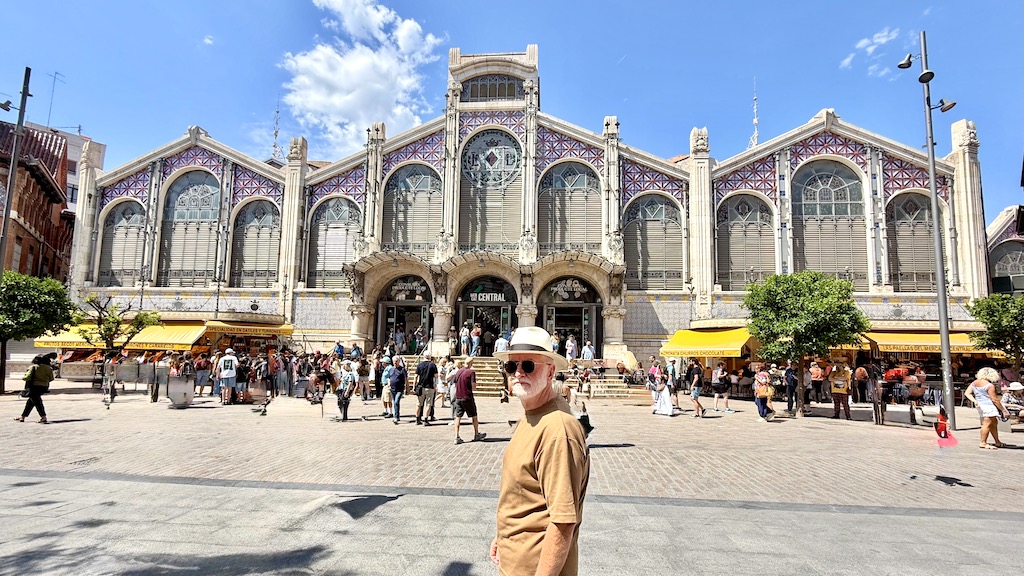
The Mercat Central is described as one of Europe’s largest and finest covered food markets, and unmissable on this Spain road trip itinerary. Not just a major tourism destination, it’s a great place to find lunch or a snack.
It also boasts the most gorgeous Modernist (Art Nouveau) architecture: built between 1914 and 1928 with spectacular ironwork, stained glass, ceramics and a magnificent central dome. The seafood section is simply amazing.


Central Market Highlights


Seeing the constant queue for the market’s famous Central Bar, we settled for a few snacks on the hoof – a tuna and tomato bocadillo, the yummiest empanadas we’ve had anywhere. We left clutching a bag of the sweetest kumquats I’ve ever tasted, some pistachio baklava and a crusty loaf for later.
Esquinita Mía
A great Argentinian bar (or bodeguita) around the corner from the market, Esquinita Mía, served up these fabulous flash-fried green peppers and some chorizo tortilla to go with our vermut rojo (red vermouth).
El Mercat Mural
Not actually a painted mural, but more of a large-format photograph by Luis Montolio. It shows the famously flamboyant Valencian cabaret artist, Rosita Amores, floating below the clouds on a giant paella pan. Find it on Carrer de la Corretgeria, not far from the Central Market.

Depressed by Gin
Gin is allegedly a downer – but you’d expect its depressive effect to take more than a few minutes.
Not so tonight, at a small bar in the Old City that shall remain nameless, mostly because I forget its name. Instead of bringing the bottle and pouring it into the balón with generous flair, as they do in most Spanish bars, this waiter brought Roy’s Tanqueray ready-poured.
Having been sternly alerted to the error of his ways, our man gritted his teeth, brought a fresh glass (possibly laced with saliva) and emptied into it a single, pre-measured jigger-ful.

Instant depression! Immediate misery. What was this accursed hombre playing at?
I’d ordered my first Agua de Valencia, a mix of gin, vodka, cava and fresh orange juice, and was quite happy with it – as happy as one could be in the company of the Merchant of Gloom.


From there, we found our way to Café Madrid, the beautifully stylish bar where Agua de Valencia is said to have been invented in 1959 by bartender Constante Gil. It’s part of the four-star boutique Marqués House Hotel. I suppose that’s why it was open this early in the evening. Again, Roy’s G&T was measured (sigh), as was my delicious Anejo 1800 tequila on ice. We got over it.
More Agua de Valencia
Review: Tapas at Orio Valencia
This was excellent! We took the option of helping ourselves from the extensive tapas buffet on the bar. Each item comes with a toothpick, and at the end they count the number of toothpicks on your plate and charge you accordingly, €2 per item. Orio Valencia also has an a la carta option with table service.


La Salvaora
For dinner on our last night, we booked at La Salvaora (Calle de Calatrava 19), both because it was highly recommended and because it was a few minutes from our apartment in the Old City. As promised, it was small, had an intimate atmosphere and served authentic cuisine. Booking is recommended.
\

Final Hurrah at Zara
To find the main shopping drag in any Spanish city, just do a search for Zara. It took us out of the old city, into the huge Plaza del Ayuntamiento and into Calle de Colón, Valencia’s busiest shopping street.

Bingo! As this would be my last opportunity in Spain – where the prices at Zara are significantly lower than in Australia and other countries – I splashed out a little bit. Who knows if I’ll ever wear those khaki gaucho pants?
Last Night in Spain: Barcelona Airport
It’s a three- to four-hour drive from Valencia to hotel Salles Ciutat del Prat Barcelona Airport, where we checked in for the night before our Singapore Airlines flight home. So convenient, with a pool, a gym and a free shuttle to the airport just 4km away.
Before dropping off the Skoda Octavia II at Hertz, we had our final menu del día (€20 pp, about A$30) at the hotel’s Sinfonia restaurant. Again, what a great deal: a five-star menu featuring a selection of starters, mains and desserts – including bread, mineral water… and a glass of wine! (In Western Australia, $30 will hardly get you a breakfast.)
Roy had the salted cod-stuffed roasted red peppers followed by a veal entrecote and potatoes and then sorbet; I had the asparagus and jamón iberico, followed by fillets of sea bream with veggies and then strawberries and cream. We’re already missing this.


Up Next?
Next week, we fly to Singapore for a week. From there, we look forward to relaxing in Phuket, Thailand for the entire month of October. Before then, with any luck, I may post something in Living Long & Strong with Verne and Roy (vernemaree.com).
If you enjoyed following Roy and me during this mammoth series on our five-week Spain road trip itinerary, please say so in the comment section below!


