
2 NIGHTS IN CADIZ, 25-27 May
Cadiz & Tarifa: more than a breath of fresh air: Cádiz will blow you away; girt by sea (like Australia); dragging Roy out to catch the sunset; the heavenly Jesú, and the real meaning of well-equipped accommodation; a bitter reflection on Zara; lunch in La Viña; La Caleta beach at sunrise; walking/jogging Cádiz Old City; Roy’s key sleep goals; to market, to market; the Oyster Bitch; ode to Old Brown Sherry; El Faro de Cádiz; on to Tarifa
Kicking off our five days in Cadiz & Tarifa, two nights in Cádiz proved to be more than a breath of fresh air. You simply can’t escape the wind. If not literally blown away by the ferocious gales, you’ll be blown away by its wonderful ambience. That’s because Cádiz, with its gently decaying edifices, is one of the oldest continuously inhabited cities in Europe and has a fascinating mix of historical and cultural influences.

As the map shows, Cádiz is located on a narrow peninsula, so it’s virtually surrounded by sea – great for ocean views from almost everywhere. And again – at the risk of sounding like a stuck record (sorry, millennials and post-millennials) – it’s just completely different to anywhere else we’ve been. In Spain, or anywhere, ever.

(You may have noted with shared concern the distance from Càdiz Old City, where we stayed, to the closest Zara. That Zara Dorca Emanuel that you see is the name of a frutería, or fruit shop … a despicable red herring, and nothing whatsoever to do with my favourite fashion store.)
Getting to Cádiz
The impressive Puenta de la Constitución gets you from the Spanish mainland across the Bay of Cadiz to the old city. (Two days later, on the way out, the GPS would be guiding us south along the at-least-as-interesting route to Tarifa via Cape Trafalgar.)

Make no mistake: though Spain has generally good roads, the driving is tiring. You’re negotiating sometimes confusing motorway configurations, including frequent spatterings of spaghetti junctions, and getting in and out of the cities can be stressful.
Where to stay in Cádiz

Then, when you get to your destination – like this one in Cádiz (above) – you arrive early and have to wait for your host (Jesú, perhaps coincidentally) in a street so narrow that you wonder how on earth other cars make it in and out. Then you see a car entering the lane, nonchalantly mounting the pavement with its left-front and left-back wheels and straddling it the length of the roadway.
Ah, so that’s how they do it! Now we know. Any hapless pedestrian simply flattens himself or herself against the wall, or ducks into a handy doorway.
Once Jesú had opened the garage for us, the parking was heart-stoppingly difficult in a tiny, cramped space with a treacherous drop-off to the right. It didn’t help that the driver seat was on the left. This is when you need a Fiat 500, we agreed. I don’t think Roy truly relaxed again until he’d successfully extricated us from this parking two days later.

Sunset at Playa de la Caleta
It had taken 20 minutes for the harried agent Jésu to arrive on his donkey (sorry, bike), deliver us from the evil noonday heat and take us up to heaven: a spacious two-bedroom apartment right in the prettiest part of the Cádiz old town, La Viña. It’s only a minute’s walk from Playa de la Caleta, perfect for watching the sunset.
As Jesú had promised, Cádiz is completely walkable. Being so close to the Avenida Duque de Najéra, the broad, long sea-wall promenade that stretches for miles, the picturesque Playa de la Caleta and its Balneário de la Palma (a mock-Moorish bathing pavilion), we could pop down to catch the sun setting over the Castillo de Santa Catalina and admire the small boats that next morning would be left high and dry by the tide.
The Levante
Once we’d recovered from the trauma of parking, and come to terms with the tortuously strangulated noise emitted by the air-conditioner all night, the Cádiz penthouse apartment (Calle de Paraguay 11) was lovely – it had spacious rooms, a well-equipped kitchen* and a nice penthouse terrace with a jacuzzi.
- For Roy, “well-equipped” means it has a dishwasher and a coffee machine. Nothing else matters. As for me, well-equipped means laundry facilities; this one had a washing machine, but no drying rack – and anything placed on the terrace would have been whisked away by the wind in less time than it takes to enquire, “Where’s my purple tee-shirt?”.
Shooting the Breeze
Here’s an actual conversation:
Verne: Roy, where’s the jacuzzi cover?
Roy: What do you mean, where’s the jacuzzi cover!?!
Cádiz is famous for the Levante, a fierce wind that blows 165 days a year, mostly from May to October. It was blowing now, with gusts reaching 88km/h and triggering a yellow weather alert, whatever that means. It blew so hard during our first night that it lifted the heavy cover from our outdoor terrace jacuzzi and flipped it over a wall – luckily down into a neighbouring terrace, and so not lost forever.

Lunch in La Viña
We had lunch around the corner from our apartment – at Hortensia, in one of La Viña’s prettiest little streets. First, sangría. Then a memorable potato salad drizzled with squid ink; another tomato salad; a slice of tortilla; and an artichoke topped with diced jamón of some sort.
And bread. Always bread. They don’t do butter much here in the south of Spain, even if you ask nicely for mantequilla in your best Spanish accent. As in the South of France, it’s olive oil or nothing.

Cádiz Old City
The next morning, I covered most of the old city by foot in the space of two hours – finding the Cathedral and the fantastic municipal market (Mercado Central de Abastos) that we’d return to later for lunch. Both the Roman ruins (next to the Cathedral) and Parque Genovés were closed for extensive works.
First, the beach: Playa de la Caleta, if anything, even more beautiful in the morning light.

I couldn’t choose my favourite pic of Playa de la Caleta in the morning, so here’s the lot.
Cathedral of Cádiz

To Market, to Market
And what a market! In the couple of hours since I’d first spotted it, courtesy of the men unloading a mess of slippery black fish from a truck, and the noon hour had arrived. All the little bars and eateries had opened for business and the place was abuzz.
More importantly, Roy had achieved his key sleep goals (overall duration, deep sleep, REM sleep, restfulness, cellular repair and so on). He was therefore in an excellent frame of mind and ready to venture forth for a spot of culinary exploration.
Cádiz being so close to the city of Jerez de la Frontera – we’d bypassed Jerez on the way from Seville – it would have been rude not to sample some sherry at this friendly bar (below). Apparently, the official name of this fortified wine’s denomination of origin is Jerez-Xérès-Sherry, recognising the city’s Spanish, French, and English linguistic heritage.
Ode to Old Brown Sherry
Most South Africans have got horribly drunk at least once in their youth on the iconic Sedgwick’s Old Brown Sherry… I know I did. It was and remains sweet, nutty and utterly delicious. (My refined mother, Sheila, preferred a much dryer and infinitely more sophisticated fino-style sherry.)


Apparently, the sword (or rostrum) of the swordfish is merely here for display purposes. It shows the size and quality of the catch, and as the espada is one of the icons of Valencian seafood, also serves to highlight the authenticity of the stall.
The Oyster Bitch
Despite her alarming self-branding, this woman of otherwise gentle demeanour courteously shucked a few fat oysters for us.

The chicharrones or pork belly bites (from one of the market stalls), were utterly delicious. Sadly, either they or the oysters – it’s hard to say which – went straight through me.

Lunch at El Faro de Cádiz, El Viño
Back to our El Viño neighbourhood for lunch at the slightly fancy El Faro de Cádiz: tuna tartare; seasoned tomato salad; and a deep-fried prawn omelette that should have been a starter but was eventually served as an unapologetic afterthought.
We often have better experiences at the smaller, less-lauded and eateries. Like Avis in its famous 1963 advertising campaign, it may be that they try harder. (As number two in car hire, Avis claimed to be trying harder than Hertz, which was currently at the top of the industry.)
3 NIGHTS IN TARIFA, 28 May – 1 June
Getting to Tarifa via Cape Trafalgar with my own seafaring Englishman; lunch at Venta Curro, Zahora; missing the boat to Tangier; Tarifa, another windy town with a beachy vibe; a historical castle, a pretty church and a mystifyingly vandalised statue; a pretentious café and a tourist trap to avoid, and four eateries to seek out; a fabulous beachside jog; Up Next are Málaga and Nerja
To Tarifa via Cape Trafalgar
As the drive from Cádiz to Tarifa is just over 100km, we had plenty of time to stop at Cape Trafalgar and find somewhere nice for lunch.

Himself an Englishman with a seafaring history, Roy had a yen to see Cape Trafalgar – famous for Nelson’s Royal Navy victory in the 1805 Battle of Trafalgar. This particular yen, though no doubt sincerely felt, did not extend to his actually parking the car and taking a little walk.

So here’s the beach in the tearing wind. What you don’t see is the holidaymakers cursing us for driving the Skoda almost onto the sand while they’re miserably trudging along, laden with kids and beach equipment.

Lunch at Venta Curro, Zahora
Lunch at Venta Curro at Zahora, just down the road from the Cape, was fabulous: tomato and tuna salad, seafood albóndigas (meatballs) in a creamy roasted red pepper sauce, and barely grilled big red prawns (gambas rojas).


Staying in Tarifa
Though an important ferry port, Tarifa is relatively small and not a major destination in its own right. So, you may wonder, why three nights in this relatively small town?
Well, we were all booked to do a day trip by ferry to Tangier, Morocco, but when we arrived to meet our guide, it transpired that I needed a visa. We’d heard that my Schengen visa would be sufficient, but that wasn’t the case… an electronic visa would have been enough, but that takes 72 hours. (I should have made absolutely sure in advance that my South African passport would not require a visa.)

So now we had two full days to unwind in Tarifa… and I found it to be a lovely destination. It’s amazing to look out across Tarifa port and know that those mountains are Africa – Tangier, Morocco is just an hour away by ferry. At the height of summer, close on a hundred ferries arrive and leave daily. I find that hard to imagine.

Like Cádiz, Tarifa is a natural kite-surfing mecca. Despite the wind, I loved this long, wide expanse of beach lapped by cool, clear little waves. I even managed to drag Roy down there for a few minutes… just long enough to take a photo of me, really. But he became so miserable that I had to relent and let him go find coffee.
A Bit of Tarifa History
The Castle
Tarifa must be the first place we’ve been to that doesn’t have a cathedral. It does, however, have the impressive Castillo de Guzman el Bueno*, a well-preserved medieval fortress that you can explore for just four euros.
- Guzmán el Bueno was a nobleman who, during the reign of King Sancho IV, heroically defended the castle during the 1294 Siege of Tarifa by the king’s rebellious brother, Juan. (As a result, the murderous wannabe killed Guzmán’s son.)
I enjoyed this great view of Tarifa harbour from the upper level.

Iglésia de San Matéo, Tarifa
Apart from the Church of Saint Francis of Asia, near the public market, Tarifa also has this atmospheric Church of Saint Matthew the Apostle, located in the heart of the Old Town.

It’s hard to imagine what was inside the mind of whoever vandalised the statue below, located near the church. And probably better not to go into that scarily vacuous space. (The vandal’s mind, I mean… not the church.)

It’s a statue of Francisco de Copons y Navia (1764-1842), put up to commemorate the defence of Tarifa against Napoleon’s army during the Spanish War of Independence. Spanish, British and Portuguese forces fought this war together against the French.
Eating in Tarifa
Maybe Avoid
To avoid tourist traps in Tarifa, it pays to check the menu. For example, the pretentious café directly across from our apartment, Espresso Bar Numéro C, where Roy picked up the keys from a lock box. It charged close to Australian prices (though not quite) and served cold, too-milky coffee. (Weirdly, the menu was in English, but no one spoke English and they looked hunted if you tried to.)


Café Central in the main square of the old town, too (on Calle de San Pedro Cortés), is perhaps one to avoid… overpriced and under-serviced. I took the photo above while we waited for a waiter who never came. Anything along this stretch is great for people-watching, however.
Three Tarifa Restaurants to Try
#1 La Palméra Churrería
It’s terribly unhealthy to start the day with coffee and churros – and I don’t really like churros, or even doughnuts – but La Palméra was the first café we found open after failing to board the ferry to Morocco. What’s more, everyone else was tucking in.
It was packed with breakfasters and incredibly noisy. Three coffees (don’t ask) and this pile of deep-fried doughnut-y things cost a mere six euros (around A$9).
#2 Damajuanas Tapas del Sur is right next to the port, so you might expect it to be a tourist trap. However, it offered great service and a well-priced menu. Washed down with white vermut (vermouth), our quail-egg-topped tuna tartare toasts were just as wonderful as they looked. I think we had chicherones, too, those hectically delicious bits of fried pork-belly.

#3 Lunch at El Ancla seafood restaurant was something else: the noise level, mostly from the staff, was unbelievable.
Originally a boat-builder’s workshop, it was converted to a bar in 1989 and later to a full-service restaurant. This no-frills eatery now has a reputation for serving some of the best seafood in the Bay of Cádiz.
#4 On the Friday, we managed to get a table for lunch at Bar El Frances, also in the Old Town. Luckily for us, as it only opens on Fridays for the weekend and doesn’t take bookings.


How do they pay the rent when they’re only open for three days a week? It’s not overpriced, either.
Such good chicherones, swimming in pork-grease and covered with fresh potato fries! Then salmorejo (the famously thick version of gazpacho that originated in Córdoba) topped with chopped bacon and boiled eggs. Finally, the chicken couscous to share – because it’s Friday, Friday is couscous day, and we couldn’t get to Tangier, Morocco to eat it there.
Our server dissuaded us from also ordering a Russian salad, because it would be too much, he said. That is so admirable… and of course he was right.


Tarifa Barber
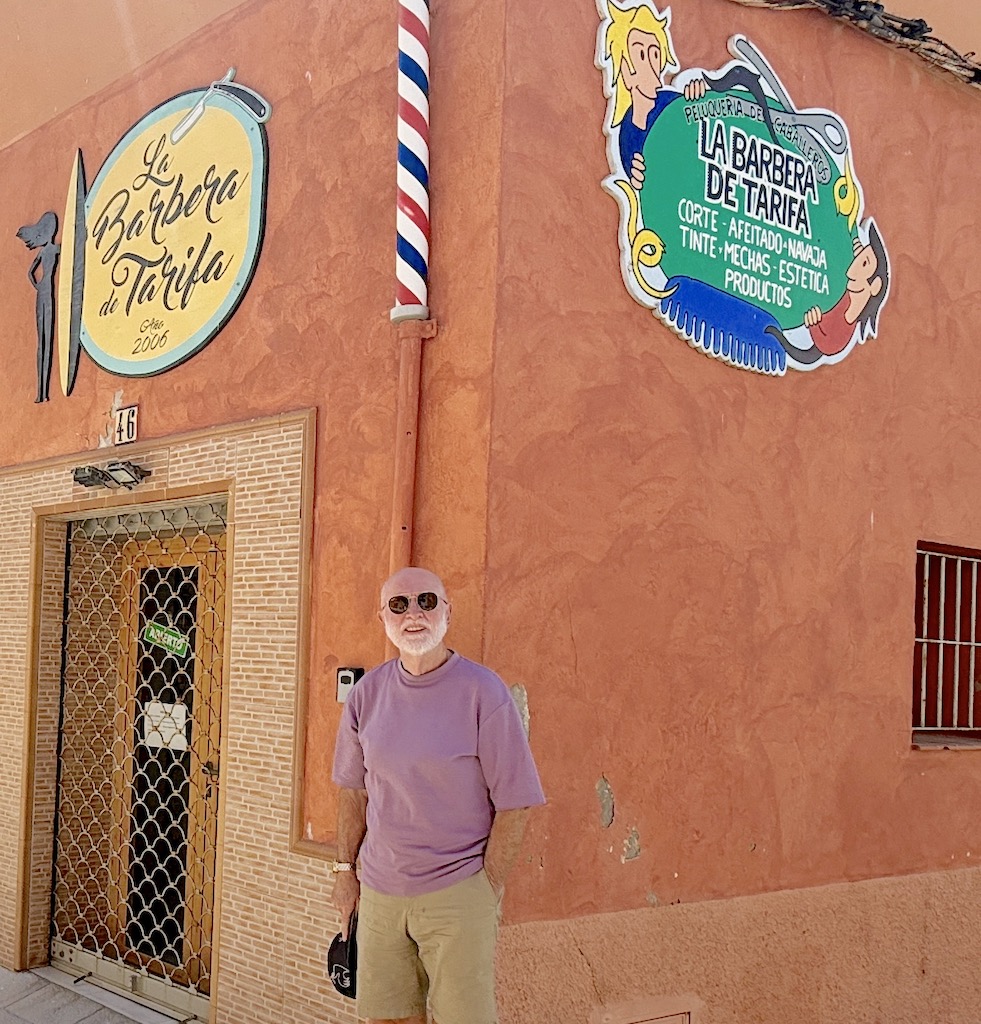
Thirty metres from our apartment was this barber shop, where for 15 euros a superb lady barber (La Barberá de Tarifa) did an infinitely more professional job than I’m capable of … and I’ve been Roy’s barber for at least 25 years (!).

Tarifa has some wonderful shopping, too: loads of independent boutiques selling creative clothing, surfing and beach gear, crafts and more. The constant wind – like in nearby Cádiz, you feel the Levante and Poniente winds funnelling through the Straits of Gibraltar – makes Tarifa a mecca for windsurfers and kite-surfers, and it has an distinctive boho-hippie vibe.


Jogging Tarifa
On our last morning in Tarifa, I turned right at the beachfront promenade to see where it would take me. The paved promenade soon gave way to a wooden boardwalk across the estuarine dunes and grass. Simply stunning!


Up Next?
From Tarifa, we head first to the fabulous Andalusian coastal city of Málaga, and from there to the nearby town of Nerja, where my sister Dale and her family have a holiday house. Road trips don’t get much better than this!



So near and yet so far – it would have been lovely to meet up – maybe on another adventure 😘
Yes, let’s work on that. 🙂